Aegis Barrier System
Modular protective barrier · Rev A

Built for the break-in and the hurricane.

A man-portable, US-made barrier panel that defeats handgun fire, passes the hurricane large-missile impact test, and holds back four feet of floodwater — then interlocks with the next panel and anchors to the ground, a wall, or a tree.

UL 752 ballistic ASTM E1886/E1996 impact TAS 201–203 Miami-Dade FEMA A-zone flood
AB-P1-L3 Operable submittal — elevation
Height class
Panel width
Protection level
Weight
55 lb
Coverage
9 ft²
Ballistic
L3
MSRP · pre-cert
$2,503
The proposition

Three threats, one certified envelope.

Most hardening products solve one emergency. A safe room isn't a flood barrier; storm shutters don't stop a round. Aegis carries all three ratings in a single panel a homeowner can lift.

Gunfire

UL 752 · Level 3 → Level 5

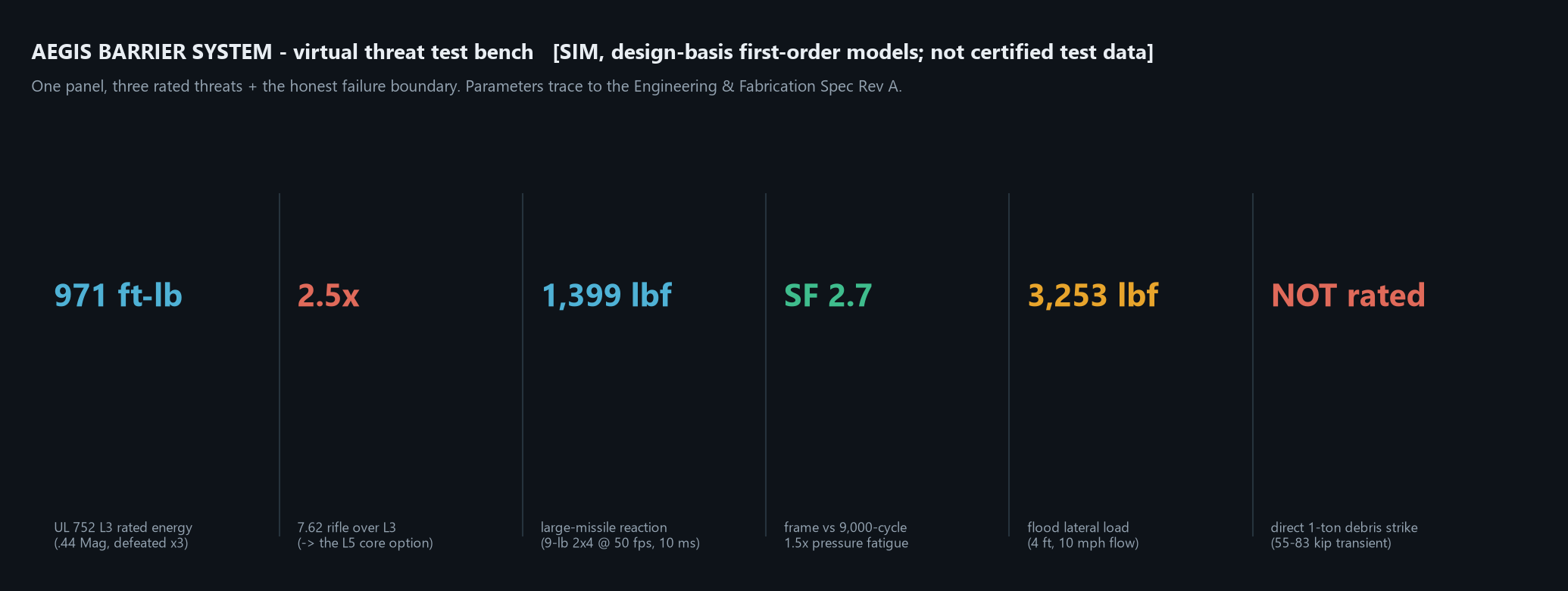
Baseline stops three .44 Magnum rounds at rated velocity. The L5 option upgrades the core to defeat 7.62 rifle. The ballistic media is purchased, commercially certified fiberglass.

Multi-hit · non-ricochet · 1-hr fire inherent to core

Windborne debris

ASTM E1886 / E1996 · TAS 201–203

Passes the large-missile test — a 9-lb 2×4 fired at 50 fps — then survives 9,000 pressure cycles at 1.5× design load without breaching.

Large-missile Level D · post-impact cyclic pressure

Floodwater

ASCE 7 · FEMA P-259 / P-55 · A-zone

The encapsulated, edge-sealed panel resists four feet of hydrostatic head plus moving-water load. The 48″ crouch variant doubles as a low flood-and-hurricane wall.

~250 psf base pressure · hydrodynamic flow rated
Construction

How it's built to survive.

Conventional steel and composite fabrication — no exotic processes. The intelligence is in the geometry: a purchased ballistic core, fully encapsulated, with every load path routed through steel so nothing ever pierces the armor.

  • CORE

    Encapsulated ballistic laminate

    UL 752 fiberglass sheet between anti-spall skins, sealed into a welded steel frame against water ingress.

  • UMI

    Universal Mount Interface

    One hardpoint map serves every mount: bottom tongue → ground anchor, perimeter points → wall or natural surface. Swap the adapter, not the panel.

  • GAM

    Ground Anchor Module

    A pre-planted receiver with a tapered funnel throat catches the tongue and cams it to center. Spike, auger, weighted plate, or leveling foot — sized to the substrate.

  • SEAM

    Shiplap + pintle interlock

    A lapped ballistic edge plus a pintle hinge lets panels set an arc from 0–30°, with a higher-rated batten covering the seam on the threat face.
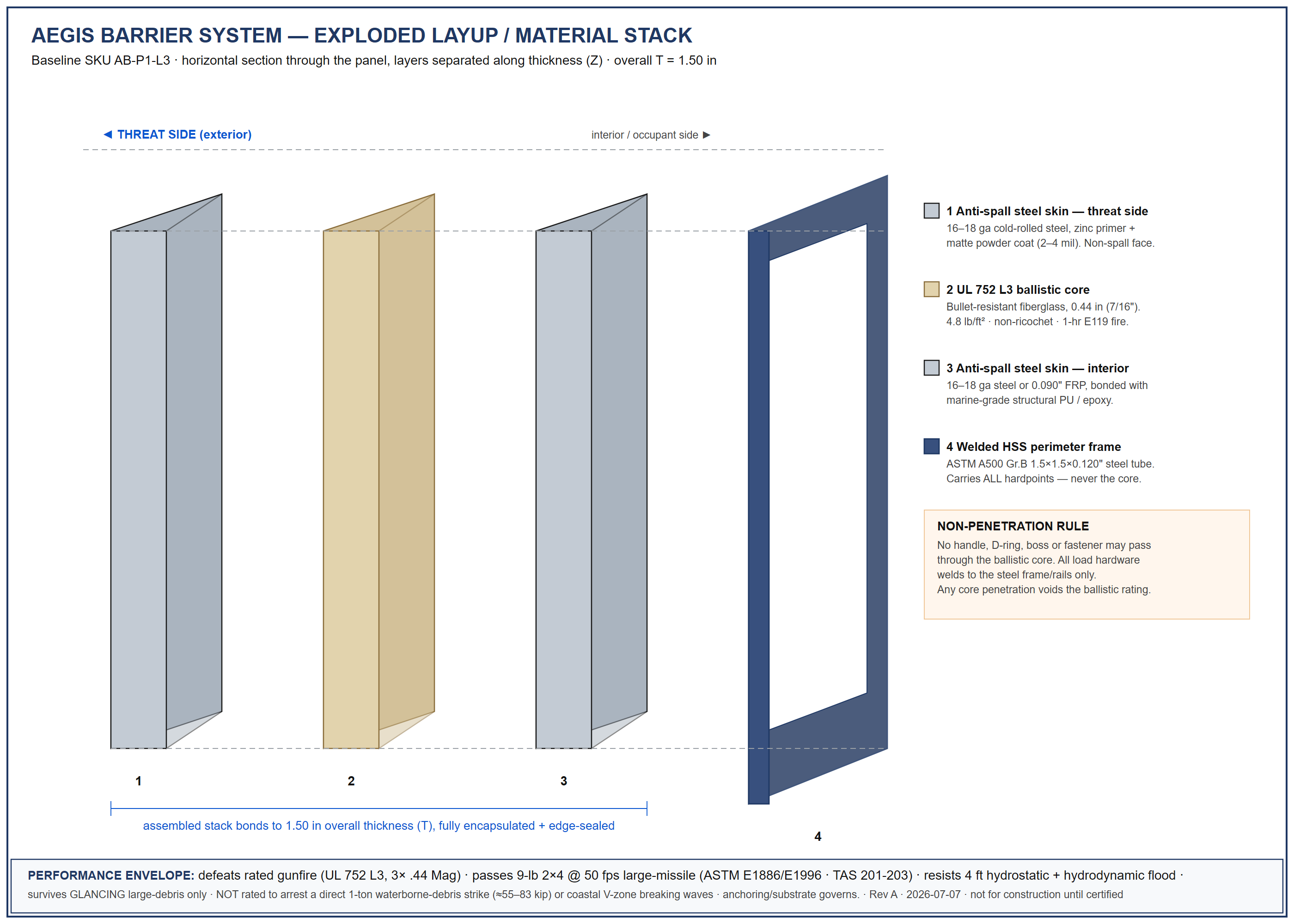
Non-penetration rule No handle, D-ring, or fastener passes through the ballistic core. Every load path welds to the steel frame — the one hard constraint that keeps the rating intact.
The honest envelope

What it does — and where it stops.

A protective product earns trust by being precise about its limits. Here is the boundary, stated plainly and printed on every panel.

Rated to withstand

  • The rated gunfire threat — handgun at L3, rifle at L5.
  • A 9-lb 2×4 large missile at 50 fps, plus post-impact cyclic pressure.
  • Four feet of hydrostatic head with hydrodynamic flow.
  • Small-to-medium windborne debris; glancing contact from large debris.

Not rated for

  • A direct strike from a one-ton waterborne object — a transient load of roughly 55,000–83,000 lbf.
  • Coastal V-zone breaking waves.
  • Armor-piercing or explosive threats — this is protective armor, not a weapon system.
  • Anything past its anchor's capacity — the substrate, not the panel, is the true structural limit.
We spec what it does and disclaim what it doesn't. Anchoring and substrate govern survival.
System lines

Configured bundles.

Panels, seams, anchors, and an emplacement dolly, rolled up into complete defensive lines. MSRP is pre-certification and rolls up directly from the cost model.

Procurement

Funding and government pathways.

A rare dual-use profile: the same panel qualifies for security channels and federal or state resilience grants.

Resilience grants

FEMA Hazard Mitigation

BRIC · HMGP · FMA through state and local sub-applicants — mitigation dollars for opening protection and flood hardening.

State programs

FORTIFIED & home hardening

State-run hardening grants such as Strengthen Alabama Homes (up to $10k per home) map directly onto the product.

Government sales

GSA · SAM.gov · DHS

Buy-American / BABAA / TAA compliant by design — a 100% domestic supply chain unlocks federal procurement.

Certification roadmap UL 752 L3 listing first (unlocks the security channel), then Miami-Dade NOA / Florida Product Approval for the impact ratings. First-year certification runs roughly $40k–$100k all-in, amortized across the production run.